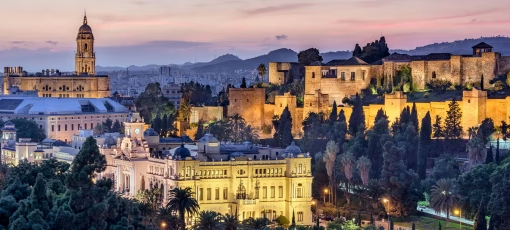
Málaga is one of the oldest continuously inhabited cities in Europe. Its origins trace back to around 800 BC, when Phoenician traders established Malaka, a strategic Mediterranean port. Today, after nearly 3,000 years of history, Málaga stands as a cultural, technological, and residential reference point in Southern Spain. The city has developed neighborhoods offering sea views, marina views, modern penthouse options, duplex apartments, and new build homes that reflect its continuous urban transformation.
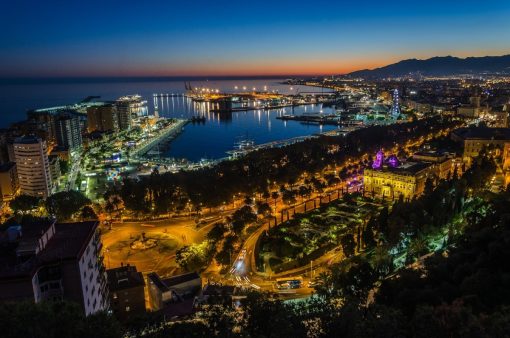
Malaga at night
During the Roman period (1st–5th century AD), Málaga became an organized municipality, exporting garum, wine, and olive oil through its thriving harbor. Roman remains, such as the 1st-century Roman Theatre, still shape the city’s historical identity and contribute to its appeal for residents seeking a blend of culture and lifestyle. Even today, areas surrounding the historic center attract buyers looking for a quiet location with access to museums, gastronomy, and premium housing options such as a golf view apartment, ground-floor apartment, or a gated community near the coast.
From 711 to 1487, under Muslim rule, Málaga became a fortified and prosperous Andalusian city. The Alcazaba, built in the 11th century, and the Gibralfaro Castle, constructed in the 14th century, symbolize this era of expansion. The elevated Gibralfaro viewpoint, one of the city’s most iconic panoramas, inspired today’s demand for Marina viewpoint apartments, high terraces, and residences with Rock of Gibraltar view–style vistas even within Málaga’s coastline.

typical tapa Bar in Malaga.
After the Christian conquest in 1487, Málaga underwent architectural and economic restructuring. By the 19th century, it became one of Spain’s most industrialized cities, fostering metalwork, textiles, and shipbuilding. This industrial heritage later transformed into modern cultural spaces such as the Centre Pompidou Málaga (opened in 2015) and the restored port area, now a lifestyle hub attracting those who appreciate beachfront apartments, private pool homes, and properties suited for short-term rental.
The 1960s marked a turning point when Málaga became a core destination on the new Costa del Sol. Tourism exploded, infrastructure expanded, and international visitors discovered the appeal of sea view apartments and luxury homes along the coastline. The creation of Málaga Airport (which reached 19.8 million passengers in 2019) accelerated residential demand and positioned the city as a global Mediterranean hub.
Entering the 21st century, Málaga reinvented itself once again—this time through technology. The establishment of Málaga TechPark in 1992, which by 2021 housed more than 621 companies and 20,345 employees, transformed the city into an innovation magnet. Digital professionals, remote workers, and entrepreneurs increasingly choose the city for its climate—295 sunny days per year—and its modern residential offerings such as new build penthouses, duplex apartments, and homes with golf course views, ideal for a balanced work-life philosophy.
Between 2019 and 2025, Málaga expanded its international presence by opening museums, improving mobility with electric buses and bike networks, and hosting major events like the Mobile Week Málaga and the Digital Enterprise Show. This cultural and technological boom reinforced demand for Gibraltar view apartments, marina views, and urban residences close to the arts district or the port.
Today, Málaga stands as a Mediterranean city where heritage and innovation coexist. Its Roman heritage, Andalusian architecture, industrial legacy, and digital transformation form a unique identity that attracts residents and investors seeking properties with sea views, front-line golf surroundings, gated community security, private pools, and a lifestyle shaped by centuries of evolution.

Malaga On December